Growing With Science Blog

Putting the fun back into scientific exploration

Seed of the Week: Sunflowers

Jul-6-2010 By Roberta

Did you identify the mystery seeds last week as sunflower seeds?

sunflower-plant

In fact they were the black oil sunflower seeds sold as bird food. Those grow pretty easily.

sunflower-close-up

Did you know sunflowers were originally from the New World? There are about 80 different species, including the so-called Jerusalem artichoke, Helianthus tuberosus. The wild kinds often have many small flowers, and many are perennials.

sunflower-wild

The lesser goldfinches were having a field day in these sunflowers.

There are a lot of different varieties of annual sunflowers (Helianthus annuus).

sunflower-lemon-drop

This is a Lemon Queen, grown for the Great Sunflower Project last year.

Many animals benefit from the flowers and seeds.

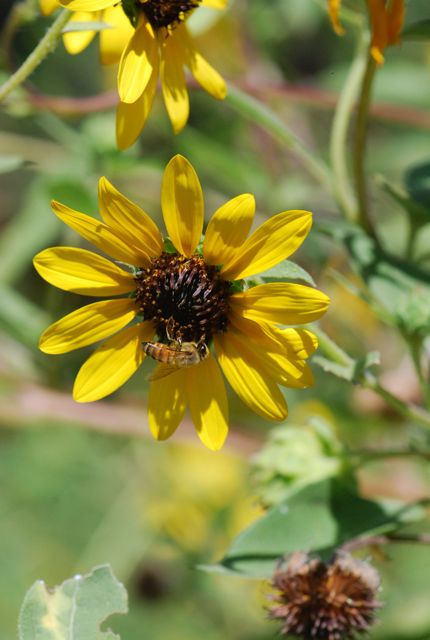
sunflower-honeybee

Many bees and other insects enjoy the pollen and nectar from the flowers.

sunflower-bird

Of course, people enjoy eating sunflower seeds, too. Have you ever had sunflower seed butter? It is a nice change of pace from peanut butter.

sunflower-single

Sunflowers are cool because the buds of some varieties follow the sun throughout the day. As the flowers start to produce seed, however, I’ve noticed that they tend to stop moving. Often they begin to drop downwards.

Here in Arizona sunflowers will grow throughout the year and they are pretty drought tolerant, too.

Have you grown sunflowers? What varieties are your favorites?

If not, you should give them a try.

Did you know that honey bees aren’t native to the Americas? The honey bee came to North America with the Europeans. The continent wasn’t lacking in bees before honey bees came, however, because a vast assortment of native bees were already happily pollinating flowers.

Like these busy native bees working our sunflowers.

sunflower bee

The pint-sized pollinators have been coming in a constant stream since the sunflowers opened.

sunflower bee

They leave each flower with yellow pollen-laden legs loaded to overcapacity . How do they even fly?

sunflower bee

Thanks to these bees we have a heavy crop of sunflower seeds. Go, bees, go!

sunflower bee

Bug of the Week: Long-horned Bees

Jul-1-2009 By Roberta

Although the weather is uncomfortably hot for humans, things are still happening out in the garden here in Arizona.

sunflower

The sunflowers we planted for the Great Sunflower Project have started to flower.

The bees can hardly wait.

A few days ago these bees were sleeping on a nearby milkweed plant.

long-horned bee

long-horned bee

Long-horned bees (tribe Eucerini in the family Apidae) are named for the long antennae present on males. They have a habit of clustering in groups to sleep overnight on plants.

I’m not sure what species these particular bees are. There are over 30 genera in the tribe Eucerini, including Melissodes (the long-horned bees), Peponapis and Xenoglossa (squash bees), and Svastra (sunflower bees).

Hopefully we’ll be seeing bees on the sunflowers soon.