Month: October 2011 (Page 6 of 6)

Mystery Seed of the Week 87

The flowers of this plant are also lovely, although very different from last week’s plant.

To give a sense of scale, these are roughly the size of small watermelon seeds.

These seeds are also found in a pod.

Any guesses what they might be?

Edit:  The answer is now posted.

Seed of the Week: Texas Mountain Laurel

The red mystery beans from last week are from a Texas Mountain Laurel or Mescal Bean, Calia secundiflora or Sophora secundiflora.

Ironically, this is one plant that I can identify by what is eating it.
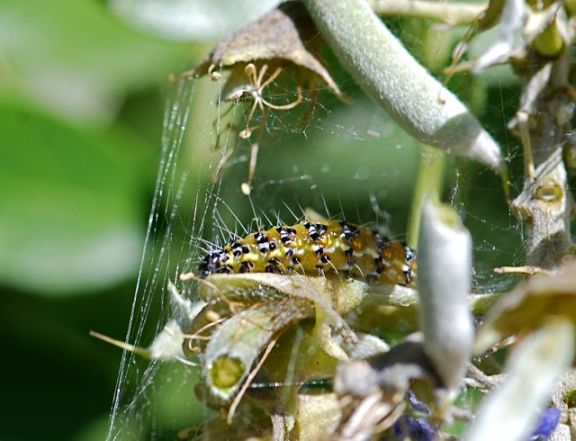
The fuzzy larva shown here is the genista caterpillar. They are often found feeding on Texas Mountain Laurel plants in the spring, causing a messy webbing. The caterpillars pupate, and then emerge as brown moths.

Of course, the spectacular blue-purple flowers help with identification as well. 🙂


Photograph by Miwasatoshi, retrieved at Wikimedia.

The flowers give off a lovely, sweet scent reminiscent of grape soda.

Texas Mountain Laurels are large shrubs or small trees that are commonly grown in landscapes. Originally from Texas and surrounding areas, they grow well in the desert. They have small, leathery leaflets, and stay green throughout the year.

The seed pods are silvery and have a fuzzy appearance. The pods are swollen around the seeds, and come to a point at the end.

The red seeds inside contain an alkaloid that can be toxic if eaten. The good news is that the seeds are also very hard. In fact, they are so hard that it is difficult to propagate the plants from seeds. Experienced gardeners recommend scarification, a process of abrading the seedcoat to make it more permeable to water.

Have you ever seen a Texas Mountain Laurel in bloom? Did you think it smelled like grape soda?

Weekend Science Fun: World Space Week

NASA image courtesy MODIS Rapid Response Team at NASA GSFC. Caption by Michon Scott.

For the second time this week we have space-related activities. First it was the Plants in Space project on Tuesday, and now it is time for World Space Week.

World Space Week is held from October 4-10 each year, and it is a perfect time to get your children/students/future astronauts excited about Astronomy. Why October 4? That’s the day that Sputnik was launched into space in 1957.

Of course I went right for the educator’s area on the website, and I found some treasures. For a free download of twenty-six pages of great activity ideas for children of all ages, check out the 2005 global edition (in English) of the Teacher Activity Guide

On the same page, the ESA edition (ESA= European Space Agency) is older version. Although some information is dated, it is 15 pages and student activities start on page 7. How can you go wrong with a title like “Eggnaut – or Houston we may have an Omelet.”

The website also has an extensive list of education links, including BBC Space and Lance’s Lab, where children are challenged to design a space station module for musician Lance Bass to live in space.

The event search will help you locate related events in your area. In Arizona there will be a series of free lectures at Arizona State University this week. Look for stories in your local news media, as well.

I particularly enjoyed seeing what other children are doing to participate throughout the world via the World Space Week Photostream on Flickr. What a golden opportunity to sneak in a geography lesson, so have an atlas handy.

I’d love to hear how you celebrate  World Space Week.

Newer posts »