Month: January 2012 (Page 4 of 6)

Weekend Science Fun: Observing Backyard Birds

It is time of year again to start planning for the Great Backyard Bird Count, February 17-20, 2012.

The Great Backyard Bird Count is easy and fun. Be sure to visit the website and read all the instructions, but in a nutshell you need to set aside at least 15 minutes on at least one of the days, gather a paper, pencil and a set of binoculars (optional) and count the birds you can see in your yard or neighborhood. When you are finished, you enter the data. Then check back to see what birds others have counted in your community.

Related activities:

1. Bird Watching

Bird watching is a popular and engaging activity. You don’t need to travel or have expensive gear to bird watch. You can simply look out the window and spot birds. Birds are interesting because they are colorful, active and can be found almost anywhere. At various times of year birds are migrating, singing, building nests and raising babies. There’s always something exciting going on among your neighborhood birds.

Are you a complete beginner? Learn your birds by figuring out a few at a time, using field guides and websites.

Keep a notebook full of drawings and notes next to your favorite birding window. Over the course of a year you will begin to recognize the regulars and also new birds.

Many communities offer bird hikes and birding classes. Check you local newspaper and do a few Internet searches for local birding clubs and events.

2. Bird Feeders
What can you do to encourage birds? Many people start by making simple bird feeders, such as the classic pine cone rolled in birdseed. Many of the crafts you see suggest using peanut butter, which is not fun at all for children with peanut allergies. Try this alternative that actually attracts a larger assortment of birds as well.

Gather:

  • dry, clean pine cones, enough for all participants
  • lard (available in most grocery stores) at room temperature
  • bird seed
  • ribbon or string
  • plate or tray to spread seed on
  • butter knife or craft sticks

Spread the bird seed on a tray. Tie the string or ribbon on the pine cones to serve as a hanger.  Have the children “butter” the pine cones with lard, either using their fingers or craft sticks, filling in the cracks. Then roll the filled pine cones in the bird seed, which should stick. (Note:  I found it was easier to tie the strings first, but you can also do it last). Hang the pine cones in a tree that you can watch and wait for the birds to discover it.

You can make another simple feeder by stringing fruit such as raisins, grapes, cherries or orange sections on a bit of twine or string and hanging it out. Just be careful and find out what works best in your region because scattering food for birds can also attract unwanted guests, including bears in some areas!

Often you can reduce the number of unwelcome guests by choosing what type of food you present and how. For example, niger thistle seed attracts colorful birds like finches and doves, but not pigeons or rats.

See our Pinterest board for more ideas.
for the birds pinterest

Check with your local Audubon Society or other birding resources for even more recommendations (see links below).

3. Nesting Materials
Making cards full of nesting materials can be a fun project that is easy to do with supplies from around the house.

Gather:

  • index cards or roughly three-inch by five-inch pieces of card stock, enough for all participants
  • hole punch or scissors
  • yarn, preferably wool or cotton
  • thread
  • hair or anything else you think a bird might use in its nest
  • string or ribbon to hang card

Brainstorm about what might be useful to a bird. Poke holes in the index cards with a hole punch or cut holes with scissors (with an adult’s help). Tie a 12-inch piece of string, yarn or ribbon through one hole to serve as a hanger. Loosely stuff the rest of the holes with a variety of nest making supplies, making sure the birds can pull it out fairly easily. When you are finished, go outside and hang the cards in bushes or trees where the birds will find the materials. Check over time to see which materials they chose first, second, etc. Refill the cards as needed.

4. Bird Garden

If you get serious about birding, you might think about planting a bird garden. Find out abut which native plants in your area provide food or shelter for birds and add a few to your garden. Providing water through a birdbath or pond is also helpful as long as the water is kept clean and fresh. Check for more information in books, magazines and on the Internet for useful plants to grow in your region or community.

5. Fly like a Bird

Study birds in flight. Make a kite, decorate it like a bird and fly it on a windy day.

Finally, even if it is raining and nothing is happening outdoors, ask your child what it would be like to fly like a bird. Then pretend you are birds. Spread your wings and soar and swoop together.

For more information try:

Audobon

American Birding Association

Cornell Laboratory of Ornithology

Bird Studies Canada

For the Birds: The Life of Roger Tory Peterson by Peggy Thomas and illustrated by Laura Jacques

For more books about birds for children, check out our growing list at Science Books for Kids.

Disclosures: I am an affiliate for Amazon. If you click through the linked titles or ads and make a purchase, I will receive a small commission at no extra charge to you. Proceeds will be used to maintain this self-hosted blog.

Bug of the Week: Insects and Their Relatives Part 2

Not many insects are out and about here today, so I thought I’d do something a bit different. A few weeks ago we found out about classification of organisms. Today let’s take a look at five of the main orders of insects and how to recognize them.

Characteristics of Five Major Orders of Insects

Scientists who name insects have grouped them into about 30 different orders (the exact number is still under debate). However, five of the orders are the most common.

1. Beetles (Order Coleoptera) – Of all the more than one million species of insects, beetles are by far the most numerous. There are an estimated 350,000 to 400,000 different species of beetles!

Characteristics:
Adults with hardened front wings called called elytra. Hind wings are generally under the elytra and are membranous (sort of like plastic wrap).

Beetle larvae are grubs or worms with a distinct head.

One type of beetle larva is called a wireworm.

Beetles go through complete metamorphosis, which means they have four life stages:  egg, larva, pupa and adult.

See the life stages of a carpet beetle

2. Flies and mosquitoes (Order Diptera)

Characteristics:

The order name of this group means “two wings.” Unlike all other insects, adult flies have only two wings, rather than the more common number of four. (The second pair of wings have been reduced to a knob-like structure called a haltere.)

Flies also have complete metamorphosis. Most fly larvae lack a distinct head and are commonly called maggots.

3. Ants, bees and wasps (Order Hymenoptera)

Characteristics:

Most adult hymenoptera have four membranous wings, with the forewings larger than the hindwings, although it might be hard to tell in a resting insect because their wings are folded. Many bees, wasps and ants have a stinger, which they use to defend themselves or subdue prey. Bees and wasps, in particular, have black-and-yellow or black-and-red warning coloration.

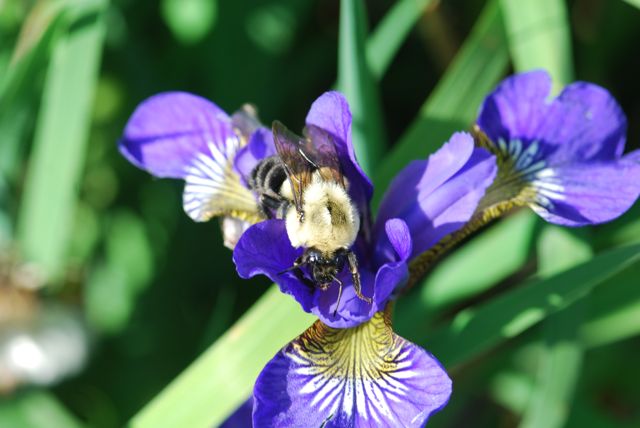
Bees have robust bodies and are usually quite fuzzy.

Wasps are usually hairless and shiny.

Ants have antennae that bend in the middle, like an elbow.


Hymenoptera also have complete metamorphosis.

Ant larvae are shaped like a crochet hook. They have a head, but no legs. The smaller, yellowish ovals are the eggs. The beige sack towards the top right is a pupa within a cocoon.

Bee larvae also lack legs. The larvae are on the left, sitting on the bright yellow bee bread that they use for food. The four white objects on the center/right of the photograph are pupae. You can see some of the characteristics of the adults, like eyes and mouthparts, in the pupa.

4. Butterflies and Moths (Order Lepidoptera)

Butterflies and moths have four large wings, usually covered with flat scales

Butterflies are brightly colored and fly by day.

In general, moths (like this atlas moth) are more drab and fly at night.

Lepidoptera also undergo complete metamorphosis.

The larvae of butterflies and moths are called caterpillars.

See this post for photographs of the butterfly life cycle and more information.

5.    True bugs, as well as aphids and cicadas (Order Hemiptera)

Note:  The Order Hemiptera has undergone several revisions over the last few decades. For a long time there were two separate orders, the so-called true bugs were called hemiptera (meaning half-wing) and the aphids, cicadas and their relatives were called homoptera (meaning uniform winged). Then the Order Hemiptera was re-named Heteroptera. Finally, based on new evidence, the two orders have been combined into the Order Hemiptera. You will see names of the earlier orders in older texts.

Insects in the Order Hemiptera have sucking mouthparts that suck up fluids rather like a turkey baster.

The “true bugs”have interesting wings that are half leathery and half membranous. They also have a triangle-shaped piece in the middle of their back.

The membranous part of the wing is between the two raindrops in this photograph of a mesquite bug. Can you also see the triangle (just to the right of the center raindrop) and the sucking mouthparts?

In this milkweed bug the membranous portion of the wing is black, the leathery part is red. Can you see the triangle?

More about mesquite and squash bugs

The aphids, cicadas, leafhoppers and their relatives have wings that fold like a tent over the rear section or abdomen.

Underneath…

…you can see the mouthparts as a tube running between the bases of the legs.

Hemiptera have incomplete metamorphosis, which means they have three life stage:  egg, nymphs (that look mostly like an adult, but lack wings) and adults.

Here are stinkbug nymphs that just hatched from eggs.

This is a cicada nymph that lives most of its life under the soil.

Once again, in this view of the underside you can see the tube that it uses to suck fluids from tree roots.

(More about cicada nymphs)

So, there’s a quick overview of how to recognize some of the insects you might find in your yard.

Please feel free to leave any questions you may have in the comments.

Mystery Seed of the Week 98

Our mystery “seeds” come from a tree that is only found in the southwestern U.S.

As a hint, it’s common name relates to an animal. People think the bark resembles this particular animal’s skin.

Do you have any ideas what the tree might be?

Edit:  The answer is now posted. By the way, these are not really the seeds, but berry-like cones.

Note:  We are quickly approaching our 100th Seed of the Week. To celebrate, I’d like to feature your favorite seed. Please send me the name of your favorite plant or seed and your first name to growingwithscience (at) gmail. com by January 19, 2012 and I’ll create a list. If it is an unusual plant, please let me know a little about it, too.

Looking forward to hearing from you!

« Older posts Newer posts »