In honor of National Moth Week, we are going to cover gardening for moths today (our regular features will return next week).
Why garden for moths? Let’s explore one example, the story of the yucca moth, and hopefully convince you to give moth gardening a try.
Yuccas are plants with sword-like leaves and white to creamy-yellow cup-like flowers that emerge on tall stalks.

Yuccas grow throughout North and Central America.
Back in 1876, an entomologist named C.V. Riley discovered that yuccas had a very special relationship with a tiny moth. The yucca moth picks up the pollen from one yucca flower and transfers it to another flower to pollinate it. At the same time, the moth lays an egg in the flower. The egg hatches and feeds on a few of the developing seeds. When it is finished eating, the larva drops to the soil and pupates underground. Back in the flower, the remaining seeds complete development and go on to become new plants. The only way yuccas can be pollinated is by the yucca moths and the only food the moths eat is yucca seeds.
This less-than-serious video shows the mutualism between the yucca and the yucca moth. It is by the Bug Chicks, from the US Forest Service’s Pollinator LIVE series.
Lean on Me from Bug Chicks on Vimeo.
Isn’t that cool?
If you are now convinced of the importance of moths, then let’s take a look how you can create a garden for them.
Like any form of wildlife, moths require food, water, and shelter. They also have some special requirements that we will tackle at the end.
Food
Plants provide food for both adult moths and their caterpillars.
Because they are often, but not always, active at night, a great way to supply food for adult moths is to design a moonlight garden of primarily night-blooming flowers. Happily, several of the plants will serve as larval food, as well.
Moth-pollinated flowers usually
- are white or pale in color
- are scented
- open at night
In the Southwest, we have a number of beautiful plants for a moth garden.
1. Yuccas (Yucca sp.)
Of course all the yuccas would be wonderful choices, because growing yuccas would help preserve both the plants and the moth.

You can see the unique flower structures described in the video in these blue yucca flowers, Yucca rigida.

Even though they are not very attractive, be sure to leave the flower stalks in place to allow the seed pods to form if the plants were indeed pollinated.
2. Datura (Datura sp.)
Daturas have a number of common names, including moonflower, which gives a clue to the fact that they open at night.

If you were standing were this photograph was taken, you would be overpowered with a sweet perfume produced by the flowers.

The morning light is beginning to touch this flower, so it will soon be gone.

Datura leaves serve as a food plant to the same species of hawkmoth (Manduca) as the flowers attract, so it does double duty.
Note:Â Datura plants are related to deadly nightshade and contain some chemicals that can be toxic. If young children or pets would have access to the plants, you might want to refrain from planting them. Also, they can be a weedy species, which means they spread very readily from seeds. You might want to control the number of seed pods that form.
3. Evening Primroses (Oenothera sp.)
Evening primroses are names for the fact their flowers open in the evening (see a trend here?)

This common species has bright yellow flowers. Evening primroses are low growing compared to plants on this list and will fit into virtually any garden.

Evening primroses come in a number of colors. The white one in this photograph is commonly called basket evening primrose, Oenothera deltoides.
Evening primroses may also be the larval food plant of a group of moths called flower moths, Schinia. For example, the basket evening primrose above is the larval food of Schinia felicitata.
4. Birdhouse Gourds, Lagenaria siceraria
We call several different kinds of plants “gourds.” This species has white flowers that open at night.

An added benefit of growing this species is that if you have a long enough growing season, you are likely to produce some nice decorative gourds.

As the name suggests, they can be made into birdhouses.

Once again, the plant is also a food source for a larval moth, in this case a budworm.
5. Cacti of various genera
Of course, not everyone can grow night-blooming cacti in their moonlight gardens, but they make a gorgeous addition if it is possible.


Most of these cacti only bloom for one night. Their pollinators must be strong fliers and must rely on other plants in the area for food, as well.
Other adult food plants to consider, depending on your area:
- Moth mullein, Verbascum blattaria
- Flowering tobacco, Nicotiana alata
- Moon vine, Ipomoea alba (be aware that some states prohibit cultivation of any morning glory)
- Night-scented or evening stock, Matthiola longipetala
- Night phlox, Zaluzianskya sp.
Moth larvae often feed on trees, so consider adding a native tree or two to your landscape.
For example, our desert willow, Chilopsis linearis,

is a food plant for a number of local birds and insects, such as
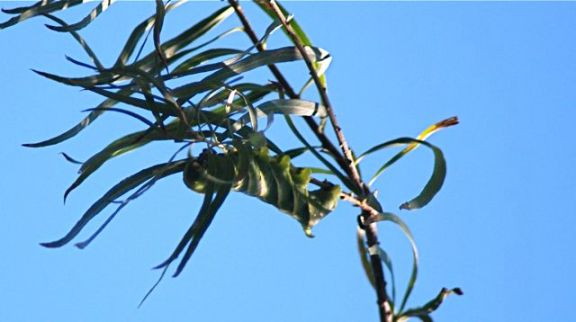
this large caterpillar, which will become a Manduca rustica moth.
Other trees to consider, depending on your location:
- Oaks
- Wild Cherry
- Tulip trees
- Hickories, etc.
Shelter
Have you ever noticed that moths fly up from under plants when you water during the day? Because moths are active at night, they need safe places to hide during the day. Providing shrubs with dense foliage and trees with deep bark gives moths a place to shelter.

Many moths have brown wings with bark-like coloration, so they can sit quietly camouflaged on the trunk of a tree during the day without being detected. This white moth is not doing so well at finding a hiding place.
Other considerations
Ever heard of the saying “attracted like a moth to a flame”? Moths tend to fly towards lights at night. Although lights bring more moths in, they also distract the moths from the things they should be doing, such as pollinating plants and reproducing. Decreasing the lights you display at night can help reduce light pollution and help the moths.
Moths are susceptible to insecticides. Lowering or eliminating pesticide use can help preserve these important pollinators.
Conclusions
Gardening is a fun hobby. Setting aside some plants for wildlife, such as moths, is a great way to learn more about what is going on in nature while discovering plants that can add beauty and a new dimension to the landscape.
Do you have a moth or butterfly garden? Do you think you might try one?
Let us know what plants and moths are found in your area.


