Category: Bug of the Week (Page 145 of 219)

Butterfly Science Books

For our science books today, let’s take a look at two nonfiction picture books about butterflies, Grow Your Own Butterfly Farm by John Malam and Monarch Butterfly’s Journey by Suzanne Buckingham Slade and illustrated by Susan Swan.

Both of these book caught our eye because of the brilliant monarch butterflies on the cover. Right now the monarchs are migrating, and what better way to learn about it than reading a good book? Monarch Butterfly’s Journey starts out with the life cycle of the monarch butterfly, chronicling the stages of metamorphosis. Once the adult butterfly emerges from the chrysalis, it feeds on nectar to get ready for the long journey ahead. Soon fall arrives and the monarchs head off on their long migration to Mexico. In the spring, the butterflies head north again. In the backmatter is a one page summary of the journey.

The illustrations are bright mixed-media collages by Susan Swan. I am not a huge fan of collage art in children’s books that tries for ultra-realism, but Swan’s butterflies are an example of how it should be done. They are fascinating and fun, with a high level of energy. I love the humorous side comments of the insects which make comments in their own cartoon bubbles. One butterfly asks, “Are we there yet?”

Grow Your Own Butterfly Farm by John Malam takes another tack, presenting the butterflies with food in the form of flowering plants so you can enjoy them in your own yard. This book starts with some facts, such as what butterflies are, what wildflowers are, and why we need butterflies. There are simple instructions for planting wildflowers and starting a garden to attract butterflies. (Oddly, on pages 16 and 17, there’s a section about how cats and birds do damage to newly planted gardens and how to keep them out of your seed beds. Because any animal can do damage to a garden, including dogs, goats and chickens, I’m wondering why cats were singled out?) At the end, the author suggests letting the plants go to seed for next year’s crop.

This book is illustrated with large color photographs with a lot of pretty butterflies and flowers. It is designed to be read by the child, so the sentences are short and it has simple vocabulary words with a glossary. It is a cute book to inspire youngsters to become butterfly gardeners.

If you have a young child interested in insects or if you are doing a unit on butterflies, you should take a look at these books.

Grow Your Own Butterfly Farm by John Malam

Reading level: Ages 4-8
Paperback: 32 pages
Publisher: Heinemann-Raintree (August 1, 2011)
Language: English
ISBN-10: 1432951165
ISBN-13: 978-1432951160

Monarch Butterfly’s Journey by Suzanne Buckingham Slade and illustrated by Susan Swan

Reading level: Ages 4-8
Paperback: 24 pages
Publisher: Picture Window Books (August 1, 2011)
Language: English
ISBN-10: 1404870296
ISBN-13: 978-1404870291

These books were provided by the publisher for review purposes.

Bug of the Week: Western Spotted Cucumber Beetle

Today’s beetle has a name longer than it is: the Western Spotted Cucumber Beetle, Diabrotica undecimpunctata undecimpunctata.

This particular subspecies is only found in Arizona, California, and Oregon.

The scientific name undecimpunctata refers to the Latin for “11 spots.” As my husband pointed out, this one looks more like it has 12 spots.

Does anyone recognize the flower?

Bug of the Week: Sap Beetles

Lately we’ve had a couple of good wind storms that have knocked the last few grapefruit off the tree.

Taking advantage of the damaged and rotting fruit are some tiny beetles.

The first thing you notice about these beetles is that they tend to shun the light.
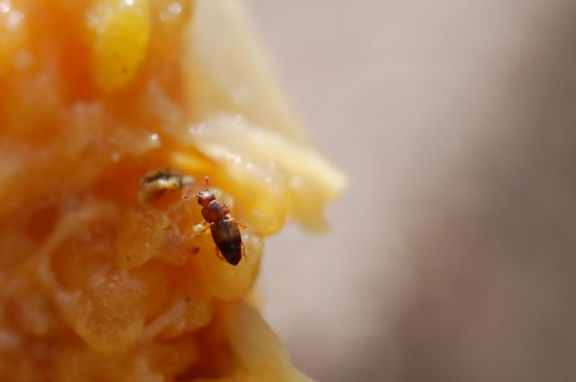
As soon as I opened the fruit, the beetles began to run. I got a lot of photographs of the bottoms of beetles disappearing out of view.

Called sap beetles, or sometimes picnic beetles, they feed inside spoiled, rotting fruit.

There goes one now. You might also notice that its hardened top wings, called elytra, are shorter than its abdomen. Also notice the nobs on the ends of the antennae. Those are characteristic of Nitidulidae, the sap beetle family.

This fruit contained two different kinds.

Can you see the similarities between the two different types of beetles?

As scavengers, sap beetles are part of nature’s clean up crew.

Have you ever seen sap beetles in fruit you have thrown in the compost heap?

« Older posts Newer posts »