Category: Bug of the Week (Page 182 of 219)

Bug of the Week: Small Carpenter Bees

If you came to visit us, you might wonder why we have old hollyhock stalks still standing in our garden. I know my husband does! 🙂

If you look very closely, you might find a clue.

The hole is a sign that something is living inside. When we opened one of the stalks recently we found:

The pithy center of the stalk had been hollowed out and a small carpenter bee had made cells for her offspring.

The bee would have started by creating a cavity. She would prepare a small ball of bee bread, a mixture of pollen and nectar. When the bee bread was ready, she would lay an egg on it and close the end with a plug of plant material. (It looks like sawdust here). Then she would make some more bee bread and repeat the process until the cavity was full. Within each cell, a larva would hatch from the egg, eat the bee bread, pupate and then become an adult bee. Eventually the new bees emerge from their chambers.

The adult small carpenter bee ( Genus Ceratina) is dark blue, greenish or black. It is much smaller than the regular carpenter bee, hence the name.

You might wonder if the tunneling by the bee harms the plant. It turns out that the living part of the plant is in the outside tissue that is not disturbed. Because a hollow tube is very nearly as strong as a solid one, the stalks are no more likely to break. Bees, like small carpenter bees, are important pollinators and should be encouraged whenever possible.

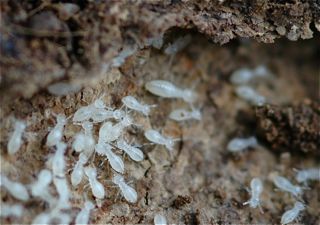
Bug of the Week: Desert Encrusting Termites

Did you figure out the mystery insect from last week?

The patches of mud you see on the trunk of the saguaro are made by desert encrusting termites (Gnathamitermes sp., probably Gnathamitermes perplexus).

These desert termites build layers of mud on the bases of saguaros or palm trunks. They also plaster mud over dry grass or twigs on the ground, particularly after a rain.  Over time they eat the grasses or twigs, leaving a hollow tube of dried mud.

On trees, they gently scrape the surface clean of dead material.

Desert encrusting termites are different from other termites because they do not enter or eat sound, strong wood. They could even be considered beneficial. Have you ever heard that termites have protozoa in their guts to help them digest the cellulose in wood? Desert encrusting termites have bacteria instead. Those bacteria are capable of fixing nitrogen, which means they actually fertilize the soil. Because the termites work on dry grass and twigs on the ground, they reduce fuel for wildfires. Finally, by tunneling in and moving soil, they aerate it, making it better for plants.

You could say that desert encrusting termites are part of nature’s clean up crew.

Bug of the Week: Another Mystery

Before I get to bug of the week, did you get up to see the meteors? Weren’t they incredible? I saw one particularly bright one shoot across the sky.

Today I have a mystery for you. In these two photos, there is evidence of an insect.

I’ll give you a hint. This is the bottom of a saguaro cactus.

Any ideas? The answer will be posted next Wednesday.

« Older posts Newer posts »