Page 101 of 561

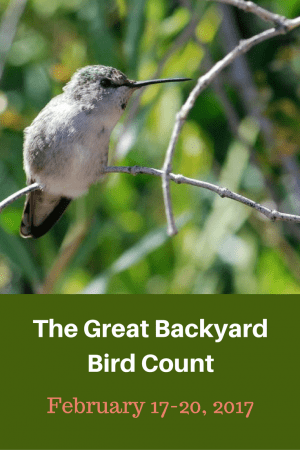
The Great Backyard Bird Count 2017

Want to learn more about your local birds? One of our favorite bird-related activities, the Great Backyard Bird Count, is coming up next month:  February 17-20, 2017.

This bird count is a prime example of a child-friendly citizen science project. Basically all you need to do is count the birds you see over 15 minutes and then report them on the website. Although it is called “backyard,” you can count anywhere birds are found, including parks, preserves, or fields.

There is plenty of information and instructions about getting started at the website.

Related:

Looking for more children’s books about birds? Check out Taking Flight: a List of Children’s Books About Bird Migration at Science Books for Kids or…

Taking-Flight-childrens-books-about-bird-migration-300x270

…the list of children’s books for young birdwatchers at Science Books for Kids

childrens-books-for-young-birdwatchers

You may also want to try:

Are you planning to participate in The Great Backyard Bird Count? What kinds of birds do you see in your backyard? Let us know!

Bug of the Week: Cotton Leaf Perforator Caterpillar

Even after all these years of recording insects in our yard, it is still possible to discover a few new ones.

Take last week. I found this tiny caterpillar feeding on a Thurber’s cotton leaf.

(I’m afraid the photograph is a bit blurry because it was a windy day.)

With a little research I found out it is the larva of the cotton leaf perforator moth, Bucculatrix thurberiella. The youngest caterpillars mine the leaves on the inside, creating tiny tunnels. When they get larger, they stay on the surface chewing out window panes of leaf tissue.

You can see photographs of the adult moth at Discover Life.

Am I worried about this caterpillar feeding on my plant?

Well, no. First of all the caterpillar is very small, and the plant is very big. Secondly, it is winter and the cotton plant is losing its leaves anyway. What difference does it make if a caterpillar takes a few bites before the leaf falls off?

__________________________________

This is what the Thurber’s cotton plant looked like earlier in the year:

You can see more at this related post about Thurber’s cotton.

10 Favorite Insect Photographs of 2016

Going over my photographs from the last 12 months, I realized I took many fewer shots of insects than in years past. It was still difficult, however, to limit the selection of favorites to just 10.

Insects Around Water

blue-dragonflyBlue seems to be the color of choice around ponds and streams.

gorgeous-damselfly_0618Blue mixed with green, that is.

dragonfly-ny_0649These photographs were taken in the company of some of my favorite people.

Insects in Fields and Pastures

flower-fly_0346A flower fly feeds on the nectar of Robin’s Plantain, I believe.

skipper-on-cloverc_0268This skipper butterfly sips nectar from a clover flower.

wood-nymph-brsh-foot_0348A tattered wood nymph rests on a leaf.

freshy-emerged-queen-butterfly-241This queen butterfly just emerged from its chrysalis.

monarch-caterpillar-27Not to be outdone, here’s a monarch caterpillar feeding on rush milkweed.

single-ant_0227What’s this ant doing on this leaf? Probably searching for nectar or honeydew.

Insects On Trees

cidada-nymph-c_0259Exoskeleton of a cicada nymph clings to the trunk of a tree.

That wraps up Bug of the Week for 2016.

Wishing you all a very happy New Year!

« Older posts Newer posts »