Author: Roberta (Page 20 of 562)

#WomensHistoryMonth2021 #kidlit Code Breaker, Spy Hunter

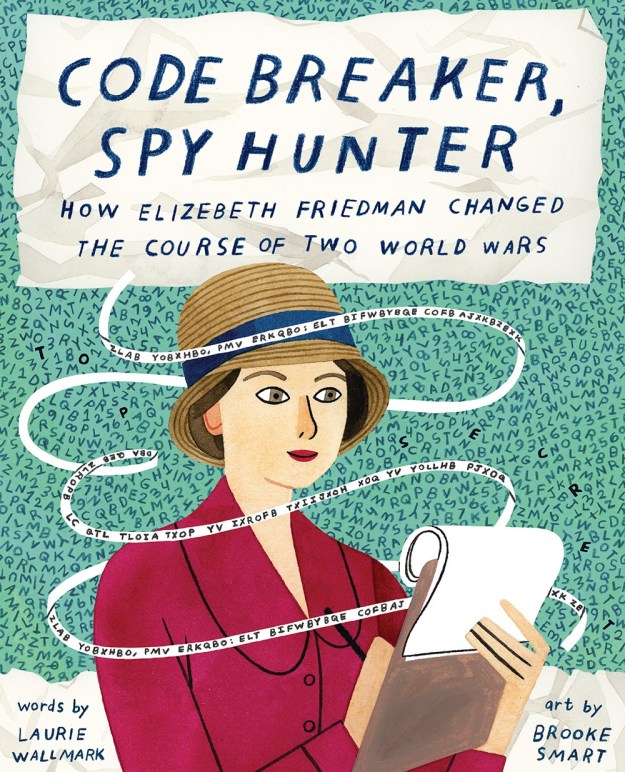
Today’s featured picture book biography is Code Breaker, Spy Hunter: How Elizebeth Friedman Changed the Course of Two World Wars by Laurie Wallmark and illustrated by Brooke Smart.

About the Book

Elizebeth Friedman was brilliant at cracking codes, but her story has been unknown for years because her work was classified. When her papers were declassified in 2015, the general public learned that during the years around World Wars I and II she uncovered spy rings, took down smugglers, and created the first cryptology unit for the CIA (at the time called the OSS).

How did Elizebeth Friedman become a code breaker? It started with a gift for languages.

After she finished college, an eccentric, wealthy man hired her to look for hidden passages in Shakespeare’s writing, ones that would give clues to who the true author was. From there, her interest in codes blossomed.

In addition to the fascinating story of Elizebeth Friedman, the book has enough back matter to satisfy the curiosity of future cryptographers. It includes information about “Codes and Ciphers”, a “Crack the Code!” activity, an entire page of information about “Cryptography Today,” a “Timeline”, “Selected Bibliography”, and historical “Notes.” There are so many pages that it flows out into the end papers.

Top Secret:  Do you see those ribbons of letters on the cover? Laurie Wallmark reveals (in an interview) that those are messages written in code! The coded ribbons can also be found in some of the illustrations. Can you figure out what they say? The back matter may help.

Discussion

Regular blog readers may be wondering how does cryptology relate to STEM? Actually it can be considered a form of applied mathematics. Code breakers look for patterns, a skill that is also useful in science (NGSS Crosscutting Concept). According to the book, when Elizebeth was assembling people for her code-breaking unit:

“She couldn’t find enough people trained in cryptology, so she hired mathematicians, physicists and chemists. She knew scientists could think analytically, a skill needed for code breaking.”

All in all, Code Breaker, Spy Hunter is a perfect choice for future spies, budding STEM enthusiasts, and up-and-coming historians alike. Examine a copy today!

Related Activity Suggestions:

  1. Check out the Code Breaker, Spy Hunter book page, where you’ll find a trailer, cool activity sheets, and more.
  2. Visit Wrapped in Foil blog for The Clothesline Code picture book about two ingenious Civil War spies who devised a code using the pattern of clothes drying on a clothesline (also with a flag code activity suggestion).
  3. To celebrate Women’s History Month, find more biographies of Women in STEM and Women Who Count at Science Books for Kids.

About the Creators:

Award-winning author Laurie Wallmark has written picture-book biographies of women in STEM fields ranging from computer science to mathematics, astronomy to code breaking. Her books have earned multiple starred reviews, been chosen as Junior Library Guild Selections, and received awards such as Outstanding Science Trade Book, Cook Prize Honor, and Parents’; Choice Gold Medal. She is a former software engineer and computer science professor. She lives in Ringoes, New Jersey. You can find her website at lauriewallmark.com.
On Twitter: @lauriewallmark
Facebook: @lauriewallmarkauthor
Instagram: @lauriewallmark

Brooke Smart loves telling stories through her illustrations, especially stories about brave women from history. She has always loved to read, and growing up she could be found nightly falling asleep with a book on her chest. Illustrating books as a professional artist is a lifelong dream come true. She is living the busy, tired, happy, wonderful dream in Salt Lake City, Utah, with her husband, their three kids, and their naughty cat named Sunshine. Learn more about her at brooke-smart.com.
Instagram: @bookesmartillustration


Reading age : 7 – 11 years
Publisher : Harry N Abrams Inc; Illustrated edition (March 2, 2021)
ISBN-10 : 1419739638
ISBN-13 : 978-1419739637

Disclosure: This book was provided by Blue Slip Media for review purposes. Also, I am an affiliate with Amazon so I can provide you with cover images and links to more information about books and products. As you probably are aware, if you click through the highlighted title link and purchase a product, I will receive a very small commission, at no extra cost to you. Any proceeds help defray the costs of hosting and maintaining this website.

#Nonfiction Monday #kidlit: The Stuff Between the Stars with a Giveaway

Right in time to celebrate Women’s History Month we have two brand new picture book biographies of women pioneers in STEM. For Nonfiction Monday, let’s start with The Stuff Between the Stars: How Vera Rubin Discovered Most of the Universe by Sandra Nickel and illustrated by Aimée Sicuro. We liked this one so much, we’re offering a giveaway in the Rafflecopter window below.

About the Book:

Vera Rubin was an astronomer who discovered some cool and important “stuff”.

From a young age, she was captivated by stargazing.

As she got older, she began to investigate swirling clusters of stars, gases, and dust known as galaxies.

Public domain image of a galaxy from Wikimedia.

She studied where galaxies were found in space and how they moved relative to each other. When she saw the stars within galaxies move at different speeds than she thought they should, she demonstrated there was something in between the stars that we can’t see or detect, something pulling the stars. That “something” had been previously named dark matter and there is a lot of it!

Discussion:

In addition to revealing groundbreaking science, author Sandra Nickel also celebrates Vera Rubin’s passion for her work and how she kept going in spite of numerous obstacles, including others not understanding her work.

It is not easy to explain big concepts like galaxies and dark matter for young readers. Sandra Nickel has nailed it.

Aimée Sicuro’s illustrations are out of this world. They vacillate between concrete and abstract, contrasting how grounded Vera was even when her thoughts were in the galaxies. You can see what I mean in the page spread below.

If you are a regular reader, you know how we love back matter and this book does not disappoint. It includes an Author’s Note, which puts Vera’s discoveries in context, a Timeline of Vera Rubin’s Life, Notes about quotes used, and a Selected Bibliography for young scholars who want to delve more deeply.

The Stuff Between the Stars is sure to thrill budding astronomers. It would be perfect to accompany a trip to a planetarium, as well as for Women’s History Month discussions. Gaze into a copy today!

Activity Suggestions:

    1. NASA Space place as a fun Galaxy Pinwheel to print out and make, as well as more information about what a galaxy is and more about dark matter.
    2. Galaxy jar craft:  Sandra Nickel describes the movement of stars in a galaxy as “like glitter caught in an invisible halo.” Check the internet for instructions for a galaxy jar craft that involves swirling glitter in a paint-filled bottle or jar. One example at Crafty Morning.
    3. Find more biographies of Women in STEM at Science Books for Kids.

    About the Creators:

    Sandra Nickel says that story ideas are everywhere; you just have to reach out and grab them.  She holds an MFA in writing for children and young adults from Vermont College of Fine Arts. Her first book, Nacho’s Nachos: The Story Behind the World’s Favorite Snack, was a Golden Kite Award finalist. Sandra lives in Chexbres, Switzerland, where she blogs about children’s book writers and illustrators at whatwason.com. To learn more, visit Sandra’s website.

    Twitter:  @senickel
    Facebook: @sandranickelbooks
    Instagram: @sandranickelbooks

    Aimée Sicuro is an illustrator, picture book maker, and surface pattern designer who received a BFA in Illustration from Columbus College of Art and Design. She lives in Brooklyn with her husband and young sons. Visit her website to learn more.

    Twitter: @aimeesicuro
    Instagram: @aimeesicuro

    Book Trailer

    Reading age : 6 – 9 years
    Publisher: Abrams Books for Young Readers (March 2, 2021)
    ISBN-10 : 1419736264
    ISBN-13: 9781419736261

    A giveaway!
    One lucky winner will receive a copy of The Stuff Between the Stars courtesy of Abrams Books for Young Readers (U.S. addresses).

    a Rafflecopter giveaway

    Disclosure: This book was provided by Blue Slip Media for review purposes. Also, I am an affiliate with Amazon so I can provide you with cover images and links to more information about books and products. As you probably are aware, if you click through the highlighted title link and purchase a product, I will receive a very small commission, at no extra cost to you. Any proceeds help defray the costs of hosting and maintaining this website.


    Looking for more children’s nonfiction books? Try the Nonfiction Monday blog.

#STEM Friday #Kidlit 13 Ways to Eat a Fly


Today’s featured title, 13 Ways to Eat a Fly by Sue Heavenrich and illustrated by David Clark, just came out last week and already there’s quite a buzz about it. Let’s find out why.

This fabulous picture book puts both the S (science) and the M (math) in STEAM. And a bunch of silly A (art), too.

The story starts with a cloud of thirteen different kinds of flies.

Big flies,
small flies,
fat flies,
thinner,
Yum! These flies are someone’s dinner.

As they travel through the book, the flies meet one untimely end after another as the reader learns about all the living things that rely on flies for their survival.

13 Ways to Eat a Fly has tidbits for everyone. The youngest readers will enjoy counting down the numbers. Slightly older readers will enjoy the gross and silly aspects, such as the absolutely hilarious chart of the edible parts of a fly along with a graphic listing the nutritional facts. Budding entomologists will soak up all the science, including the common and family names of each of the flies, interesting details about the predators, and an introduction to food chains. Educators will enjoy two pages of suggested books and websites in the back matter, so helpful for digging deeper.

Not sure you really want to read about icky flies? Don’t worry, by the time you’re done, you will be rooting for them!

Ever wondered how an author gets an idea for a book? You’re in luck. This week I talked with author Sue Heavenrich by phone. Be a fly on the wall for our conversation!

You’ve written a book about insects for children. Were you interested in critters when you were young?

When I was a kid, I kept a notebook of organisms – sort of like a “life 
list” birders keep, but with animals and plants that I got to know. I
 loved to make lists: all of the kinds of squirrels found at the Grand
 Canyon; the different kinds of trees at the Girl Scout camp; what the
 black widow spider living in my window ate for breakfast (don’t tell my
 mom – she still does not know about that spider!) So I am thinking it’s 
not a surprise that I would begin to write a book about flies by making
 a list of flies seen in and around my garden.

That is so cool. Keeping a notebook and making lists are great tools for learning. Where did it take you?

I got my master’s degree in biology working on insect behavior studies with Michael Breed at U of CO, Boulder. Two of the papers I published (My name was Susan K. Smith at the time):

  1.  In Animal Behaviour
  2.  In Physiological Entomology

It is fascinating that you studied cockroaches (I’ll have to tell you my cockroach stories some time.) Right now, I’d love to hear more about the garden you mentioned.

I have a vegetable garden. It is not so much about growing food, but it is a place to observe and learn about other living things. Definitely about the woodchucks, chipmunks, and beetles!

A few years ago I got involved with the  Great Sunflower Project, a citizen science study facilitated by Gretchen (LeBuhn). We grew sunflowers and counted the bees and other pollinators that visited. As a result, I got into gardening for bugs.

I grow plants with the aim to attract native insects and my yard has dandelions, violets, buttercups, etc. I enjoy looking closely at the insects that visit. I am especially fond of bumble bees, which are the teddy bears of the bee world.

Once I found an insect that looked like a hornet, but something was not quite right. It had two wings and the antennae looked wrong for a wasp. Turns out it was a fly that mimicked a hornet. That made me start thinking about the diversity of flies, and you guessed it, eventually led to the book.

We are thankful for that fly!
Besides in the garden, where else can we find you?

I blog about science and STEAM books at Archimedes Notebook
(archimedesnotebook.blogspot.com) and folks can visit me at my website www.sueheavenrich.com

Thank you so much for your insights and sharing your interest in flies. Maybe some day we will all have gardens for flies.

Activity Suggestion:

Start a fly or insect notebook like Sue did. This can be a paper notebook or if you are older and have a phone, you can use apps like iNaturalist.

Keep records of the flies you see. Make a list of common and scientific names. Find out more about each type of fly in books or websites like the ones listed in the book.

If you like to draw, add illustrations to your notebooks. Drawing requires close and accurate observations. It is a useful skill. You can strive for scientific accuracy and have fun like David Clark did.

If you have a camera, you might want to take photographs. I keep photographic records of the flies I see around my yard in this blog.

Think flies are bland and boring and only eat garbage? Check these out!

Bottle Flies – Family Calliphoridae (prev. post)

Fun fact:  Bottle flies pollinate specialized carrion flowers like Stapelia (previous post).

Long-legged flies (Dolichopodidae)

Fun fact:  The adult flies are beneficial in the garden because they are predators of other small insects like aphids and leafhoppers, as well as spider mites (previous post).

Crane flies (Tipulidae)

Fun fact:  Although they may superficially look like giant mosquitoes, crane flies in a completely different family. They are fragile insects, not harmful in any way (previous post).

Bee Flies (Bombyliidae)

Fun fact:  Like bees, bee flies are pollinators. They use their long mouthparts to suck up nectar from flowers (previous post).

Hover or Flower Flies (Syrphidae)

Fun fact:  Adult flower flies pollinate flowers and the larvae eat aphids. Win-win!

Featured in the book:  Mediterranean fruit fly (Tephritidae)

(Photograph by Alvesgaspar at Wikimedia)

Mediterranean fruit flies are potentially invasive pests. Some states, particularly California, have extensive monitoring programs. If even a single fly is found, they spring into action to prevent it from taking hold.

Fruit flies (Drosphilidae)

Can you tell this regular fruit fly from the Mediterranean one above? Hint:  Flies in the family Tephritidae are also sometimes called “picture-winged” flies. Let us know the differences you see in the comments.

This family of fruit flies are not in the book, but are important. The study of fruit flies has led to incredible scientific advancements in the fields of genetics and embryology.

Fun fact:  Fruit fly larvae consume fruit that is rotting or fermenting. They eat the fungi/yeasts in decaying fruit as an important source of protein ( Nature article, previous post, previous post with life cycle).

So, do you think flies are cool now?

Reading age : 4 – 8 years
Publisher : Charlesbridge (February 16, 2021)
ISBN-10 : 1580898904
ISBN-13 : 978-1580898904

Disclosure: Book is my personal copy. Also, I am an affiliate with Amazon so I can provide you with cover images and links to more information about books and products. As you probably are aware, if you click through the highlighted title link and purchase a product, I will receive a very small commission, at no extra cost to you. Any proceeds help defray the costs of hosting and maintaining this website.

Come visit the STEM Friday blog each week to find more great Science, Technology, Engineering and Math books.

« Older posts Newer posts »