
In another in our series of STEM story times, let’s explore reptile-themed books, learning centers, and activities.
 The Books:
To start story time, I began by reading an older picture book from my bookshelf, Lizard in the Sun by Joanne Rider and illustrated by Michael Rothman.
Although this book works well when read one-on-one, it was a bit long for a group of preschoolers. They began to distract each other.


After talking about what reptiles are and visiting the activity stations, we finished with their choice from a pile I provided, Get to Know Gila Monsters (Get To Know Reptiles) by Flora Brett.


STEM Activity Station 1. Lizard in the Sun (Under a lamp)
Explore the concept of “cold-blooded” or ectothermic (having a internal temperature determined by-and-large by the external environment.)
Gather:
- Two lizard shapes cut from black construction paper
- Small desk lamp
Place one lizard shape directly under the lamp and one at least three feet away, preferably in a shaded or dark area. Have the children compare the temperature of each.
(Older children could record the temperature difference with a thermometer.)
Optional:Â Added graphic of temperature vs. lizard activity on page 3 from Sonoran Desert Museum’s Leaping Lizard’s handout.

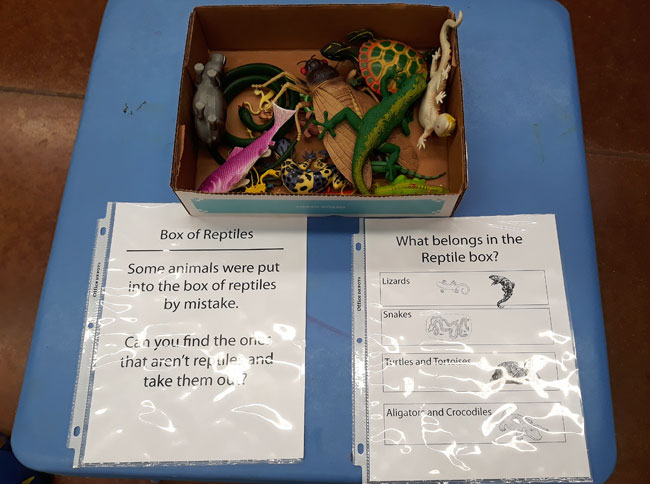
STEM Activity Station 2. Box of Reptiles (Sorting activity)
Gather:
-
-
- Toy or model reptiles:Â snakes, alligators, lizards, turtles
- Box or bin
- A few toy or model animals that are not reptiles:Â mammals, birds, insects, fish, or frogs
-
Mix the animals in the box or bin. Prepare a sign that reads:Â Some animals were put into the box of reptiles by mistake. Can you find the ones that aren’t reptiles and take them out?
STEM Activity Station 3:Â Senses Learning Station
Gather:
- Images of snakes with prominent heat sensing pits (sense heat)
- Images of snakes tongues and Jacobson’s organs (smell)
- Point out the eyes (sight)
- Hearing- although reptiles don’t often have obvious ears, they can hear
Place this station near the lizard in the sun station so can compare how we detect heat with how a snake detects heat.
(

STEM Activity Station 4:Â Make a macaroni snake craft (fine motor skills)
Gather:
- Chenille stems (pipecleaners)
- White glue
- Pasta shells
- Penne (red lentil for color)
- Marker
- Red craft foam cut into tongue shape (Y)
Make a loop in one end of the chenille stem to form the head. Feed the penne onto the chenille stem to cover the body. Bend the end back to hold the penne on. Add eyes to a pasta shell and slip over the head loop. Glue into place (do this after the body so it doesn’t get dislodged). Glue on the tongue. Allow glue to set before playing with the snakes.
 See our previous snake craft using paper beads and a more detailed pasta version at The Pinterest Parent.
STEM Activity Station 5:Â Make a reptile book
Gather:
- reptile book PDF – print out number of copies needed
- Scissors
- Markers/crayons/colored pencils to decorate
For instructions how to fold the book, visit the Making Books website or watch this video:
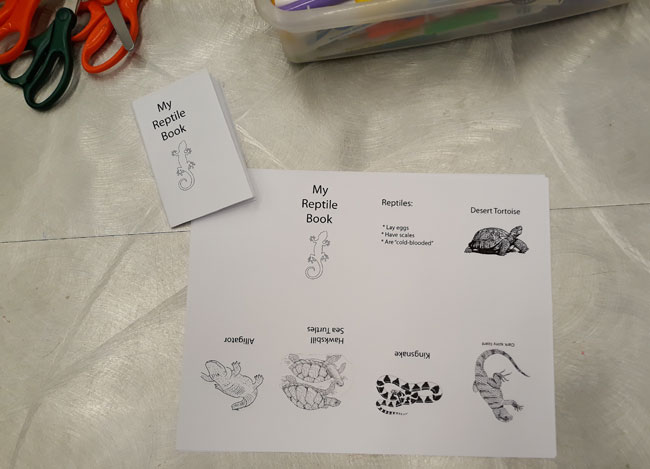 Note:Â This project was a bit too difficult for preschoolers, but their parents seemed to enjoy it. The children will color/decorate them at home.
Mini field trip:
The center where the story time was held had a timely exhibit of snakes and lizards, so we made a mini field trip to see it.
 The information about Gila monsters probably sparked the children’s interest in reading the book about them at the end of story time.
 The exhibit included an actual shed snake skin to touch. Cool!
Pointed out the different sizes and shapes of the scales on the bottom versus the top.
This unit was a hit. Please let me know if you have any questions or comments.
********
Visit our Pinterest Board for more reptile STEAM ideas.
 Want to read more children’s books about reptiles? Try our growing list at Science Books for Kids.


