Category: Bug of the Week (Page 191 of 219)

Bug of the Week: Jumping Spiders

The jumping spider photos seems to be piling up, so maybe today would be a good day to use them.

jumping spider

Jumping spiders have two large round eyes on the front of their cephalothorax (we’d call it a head), as well as six smaller ones to the top and sides.

jumping spider

Jumping spiders are fairly tiny as spiders go. They sit on plants waiting for insect prey and when they see something, they jump with their stout legs.

jumping spider

Many jumping spiders are colorful. This one looks like a tiny zebra. or maybe that should be tiger…

jumping spider

This jumping spider had red markings on its abdomen.

jumping spider

It was trying to catch bees and flies coming to visit these large flowers.

jumping spider

jumping spider

Jumping spiders have retinas in their eyes, so the eyes change color as they look around. If their eyes go dark, they are looking right at you. Compare the eyes of this spider to the top one.

Have you seen any jumping spiders lately?

Bug of the Week: Sunflower Insect Update

Some of you may remember from the Academy of Science and Technology Blog Carnival 3 post that we are participating in the The Great Sunflower Project.

We got our package of lemon queen sunflowers (Helianthus annuus) in the mail, planted them and were pleasantly surprised when they started to grow like crazy.

sunflwer plant

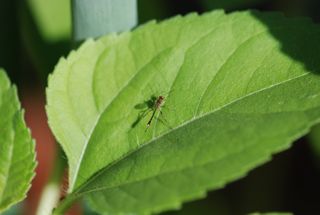
This morning I’m happy to report the first bee. No, the flowers haven’t opened yet, but here is a tiny sweat bee resting on a leaf.

sweat bee

It is about the size of a pencil lead. It has been visiting nearby flowers. Can you see the pollen?

sweat bee

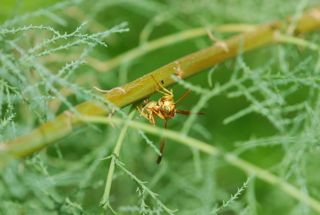
A parasitic wasp was also sitting on a sunflower leaf.

parasitic wasp

Are these insects merely resting in the warm sun?

A clue to what they may be doing comes from the black spots you see on the sides of the photos near the base of the leaves.

ants

Those are ants.

What are the ants doing? Now, many people might think the ants are “eating the plants.” In a way the ants are, but not by chewing on leaves or harming the plant in any way.

It turns out sunflowers have extrafloral nectaries. As I explained in a previous post,  extrafloral nectaries are structures on the plant in places outside of flowers that provide nectar for insects, often ants.

Ants of the Southwest some great photographs of ants sipping nectar from the extrafloral nectaries of a sunflower. Photo 1 and Photo 2. Notice how hairy sunflowers are.

Sometimes bees and wasps may take advantage of the sweet liquid nectar as well.

Just think, insects get their breakfast from a plant and not a flower in sight.

Bug of the Week: Paper Wasp

This morning it has been partly cloudy, but during a burst of sunshine I was able to catch a photo of this paper wasp, Polistes flavus.

paper wasp

Any idea what she might be doing?

paper wasp

Look how shiny she is. Her eyes are shaped like kidney beans. She has three smaller eyes called ocellae in a triangle at the top of her head.

She was hunting for caterpillars and other insects. Wasps feed their young larvae bits of insects they catch and bring back to their extraordinary paper nests.

You might wonder whether I was in any danger taking this photo. In fact, this species of paper wasp that we encounter in Arizona is surprisingly unassuming. Unless you directly threaten their nest, they are not likely to sting. Their nests are often hidden in the dense foliage in small shrubs, such as rosemary bushes or under red yucca (hesperaloe) in our yard. We are much more likely to be stung by bees than these wasps.

I have noticed several paper wasps around my mint plants lately. I hope they are catching the cabbage loopers that have been devastating the plants. Go wasps, go.

« Older posts Newer posts »